Showing posts with label home education. Show all posts

Tuesday, May 7, 2019

Pathway To Liberty (A Homeschool Crew Review)


For the last few weeks, the kids and I have been using the Pathway to Liberty's History Curriculum  from Pathway to Liberty Homeschool Curriculum in our homeschool.


The Pathway to Liberty curriculum is a complete history curriculum for grades K-12 that bring students through the different periods of history over four years of coursework.    This curriculum is written by Jayme MacCullough, founder of Pathway to Liberty and is designed to present history in an engaging format using a Christian worldview.


Each year of coursework is also broken down into one of four levels, depending on the grade level of the student.  Startling with Level 1 which encompasses K5-3rd grade, Level 2 for 4th-6th Grade, Level 3 for 7th-9th grade and finishing with Level 4 for 10th-12th Grade.  To teach each level only requires the purchase of both the Teacher's Guide and the Student's Guide for that level. Lessons are designed so that multiple levels can be taught at the same time to multiple students.

Members of the crew were each given their choice of both Year and Level to use in their homeschool.  For this review, I opted to use the Year 3 - US History curriculum at Level 2 with both Ashleigh and Garrett.  We were given a digital download of the Teacher's Guide, Student's Guide as well as a digital download of the book Chain of Liberty that is used with the curriculum.

How We Used It

Each Monday, I would simply print out the handouts needed for the week from the student's workbook.  Each week, the teacher's manual would lay out what the lessons would be about as well as the scripture and main ideas that are stressed during the week.  The weeks reading lessons are laid out and are completed over the course of 4 days.   For the weeks that we have been using the curriculum, we used the book The Light & The Glory for Children by Peter Marshall and David Manual as well as Chain of Liberty, also written by Jayme MacCullough, the author of the Pathway to Liberty curriculum.  Later lessons use the book From Sea to Shining Sea for Children, also written by Peter Marshall and David Manuel.


Both the Teacher's Guide as well as the Student's Guide are both very user friendly. The Student's Guide allows for super easy printing of all the necessary work for the week.  With the Teacher's Guide,  everything is planned out - what you will read, what questions you will ask, the answers to those questions.  There is also suggested writing assignments, additional reading

Each day, we would read the selection together and go over the questions included with the study guide.  If a video was required for the week, we would typically watch it on Fridays.

The first day of the lesson, the kids and I would go over the Scripture, Principal and leading idea for the week together.


For this particular week, we read about the different hardships that the pilgrims faced, including running out of food.  The one part that stuck out with the kids was that at one point, they only had 5 kernels of corn as a ration to eat each day.  To really drive this home with the kids, we grabbed some corn kernels so they could put into perspective the exact amount they had to eat each day.


Some exercises included each week included map work and charts.


Most exercises were questions that required the kids to think about and apply what they read.


My Opinion

So, here's the hard part.  What do I think of this curriculum.  I REALLY wanted to like this curriculum and I was super excited when I was given this review.  So far, part of me really likes it, and the other part of me doesn't like it much at all. 

Let me explain...

Based on the first 7 weeks of these lessons - As far as as an actual US History curriculum, I don't like it.  I just feel that there's not enough meat to this to really teach history itself.  Granted, we're doing Level 2 studies, but Nine weeks into it and the kids have learned a few tidbits here and there in regards to the early settlers of America.  However, those tidbits do not equate to a solid learning of the topic.   I also questioned how much of the material covered within the stories were factual or if they were fictional fluff.   There are stories that are read in this curriculum that I can't verify if they have any factual basis to them and that bothers me.  I do not like to "rewrite" history to serve an agenda and I do feel that this curriculum might do that to some degree.

Another reason I don't necessarily like this curriculum is the amount of writing that is needed.   Between copy work, word studies, and answering questions, I felt we were spending WAY too much time writing things that weren't really necessarily history related.  Garrett absolutely hated the writing portions and I'll be honest and say I don't think the kids got much as far as educational value from these assignments.  For example, while the reading mentioned where Plymouth, Cape Code, Roanoke and Jameston were located, these facts aren't asked for the kids to remember or recall, but instead questions focus on a more spiritual nature and answering questions in regards to how Biblical principles were showing by a figure in the reading. I don't necessarily mind a Christian worldview of history, but I want the main focus to be the actual history.

However, I did really like the video recommendations that were given for a few of the lessons, usually for the 4th day.   I think the kids got much more of their learning each week from these.  One video that was included with the lesson on Jamestown showed them excavating an old well and the kids really liked seeing what was brought up out of it. Another video was a virtual field trip to the  Plimoth Plantation that had actors portraying people who lived in that time period, both settlers and Native Americans.   Both of these videos were well received by the kids.

One thing we did have an issue with was that the reading plan for Chain of Liberty did not meet up with what the lesson plan suggested for the day.  For example, for one lesson we were suppose to read a portion of the chapter entitled "The First Colonies" . We were told to read pages 78-82a.   However, that particular chapter started on page 83 and we had no idea where to stop and just had to guess to the best of our knowledge.

With that said,  I do think this particular course ranks better as maybe a character building curriculum that could be used in conjunction with a more solid U.S. history course.   Much of the reading is about relying on God and how when one ground of people (the settles of Jamestown) had the wrong intentions (finding Gold instead of spreading God's Word), they failed yet when the Puritans came to spread the word, they found favor with God and were provided for.   These types of lessons are great for character building and Bible study, and while I do appreciate the Christian based theme of the lessons, I personally want more when learning history.    That's why I feel that this might work better in conjunction with another curriculum where the lessons could be used along side to provide a more spiritual look at what was going on.

One final thing that I really do appreciate about this company is that they offer a 20% discount to all Active Duty Military families.

Overall, I don't think this is a curriculum that I will continue as a sole US history course but will use as a supplement with my other US curriculum. I think together, they would create a really well rounded curriculum.


To find out more about Pathway to Liberty and their different history curriculum, be sure to visit their website.  You can also find them on the following social media sites:


While my personal opinion of this curriculum might not be 100% positive, there are other members of the Crew who have used the Pathway to Liberty curriculum so be sure to click the banner below and read their reviews.

Universal History,  The Middle Ages,  US History & World History Curriculum {Pathway to Liberty Homeschool Curriculum Reviews}


Monday, March 2, 2015

Learning Patience


Learning Patience...


This is something I really need to work on. I get upset with myself a lot because I find as I have gotten older, my temperament fuse has gotten much shorter. A short fuse is not a good thing when you are homeschooling.

I hate being this way.. I hate when I raise my voice at my kids when the day isn't going well. I know my kids do not like it either.

Today I had one of those moments. We were sitting together working on our school work, which already
The Face of a Frustrated Child
wasn't going the way I would have liked. It took almost an hour just to get though a reading of “Oh, The Places You'll Go” by Dr Seuss, a book that should have taken about 5 minutes. My daughter's cat was being annoying, climbing over everything and wanting attention – my youngest daughter hates the cat and is scared of it so as soon as the cat came into proximity, Ash was freaking out. I finally ended up having to lock the cat in my bedroom just to get through the book but the tone had already been set.

I gave the kids a handout with a word find to go along with the book.. The kids normally enjoy word finds but not today. Garrett wouldn't even look at it and even cried when he was told he needed to write his name and Ash threw her pencil at me and declared she didn't know what the letter B was, much less the word Balloons (a word she knows and had read only a few minutes before).

Somehow we managed to get through our reading and moved on to Botany. I only got two pages into the reading and even that took close to an hour.. I'm not sure what happened that actually caused me to snap, that's how insignificant it was, but snap I did. I am ashamed to say, I yelled at my kids and I am sure it was something along the lines of “Sit your butts down, turn around and pay attention or you'll go to your room and there will be no games and no kindle today”..

That's when my son looked at me and he said “Mom, are you frustrated?”

“Yes, Garrett, I am frustrated and I am sorry I yelled at you because of it.”

I then realized that none of us were going to get much accomplished for the day so we decided instead to have lunch early. Along with their grilled chicken, the kids also had smoked peanuts in their shells as a snack.

Guess what? We ended up having a very nice discussion about peanuts came from plants, what day did God create plants, why we use latin in science and why it's considered a dead language. Basically, we ended up having our lesson without the kids even realizing we were having a lesson, we accomplished most of what we were suppose to do today (I'm letting them slide today on our math program) and we both got to calm down. That's a win in my book.

Frustration Happens to the Best of Us


There's not a parent in this world who hasn't lost their cool at some point or another and if anyone tells you differently, they are a liar. We've all been to that point where something very minor results in a major blowout. It might not be at your kids – maybe you hold it in til your spouse gets home and you blow up at them instead. Maybe you take it out on another parent at your kid's sports practice or dance lesson. Maybe it was yelling at someone you don't know in another car. No matter who or what caused it, we have all had one of those moments and we almost always immediately feel ashamed of it.


One of the things I've been asking myself a lot lately is if my kids were in public schools and they came home one day and told me that their teacher had yelled at them and said some of the things I have said in my own frustration, how would I react. Would I be okay with someone else talking to or treating my kids that way? If not, then I should not be doing it either.

In the past few weeks, I have found myself praying a lot for patience. I even told my husband I had been asking God to help me with finding patience. In this search for patience, I'm finding insight not only with my own temper but also with the kids as well, things I don't necessarily like. I'm learning that my kids have basically gotten use to mom raising her voice and don't pay much mind to it. Some parents would justify their behavior by saying “It's better to yell at them then to physically discipline them”.. Luckily, I have never been on to spank my kids but I feel terrible for kids who do get spanked because they don't perform the way a parent thinks they should in homeschooling.

In my asking for patience, God pressed upon my heart the true meaning of “Discipline”.. When we hear the word discipline, we often think of a punishment of some sort in response to a wrong doing. However, that is not what the word actually means. Discipline is a Biblical concept that simply meaning to train, teach, and to instruct. The 12 Disciples were called disciples because they were learning from Jesus. Jesus did not instruct them by yelling at them, hitting them or by other forms of punishment. Instead, he instructed them with love and compassion and we as Christian parents should learn from him and instruct our children the same way.

What To Do When Frustration Gets to You


Next time you find yourself on the brink of losing it, try a few of these suggestions and see if it helps.

  1. Take a Break - sometimes just taking a breather from the situation will help to snuff out your fuse. Let the kids have a snack, tell them to read independently (if they like reading) or have them color/draw while you take 15 minutes to relax and reset.
  2. Attempt the lesson in a different setting – Many times a change in scenery will make a huge difference. Turn on or turn off some lights, open the curtains and let some sunlight in. Open the windows and left in some fresh air or even go outside.
  3. Physical activity – If your kids are being hyper and won't sit down for lessons, physical activity might be just the thing to help burn off that excess energy and allow them to concentrate. Buy a cheap $3.88 rubber ball from Walmart and have an impromptu kickball game.
  4. Essential Oils – It is believed by many that certain smells can trigger receptors in the brain that stimulate emotional responses. Lavender, rosewood, chamomile, and clary sage have all been said to help create a calming environment. Try putting them in a diffuser in the room to help sooth both you and your kids.
  5. Take ten deep breaths – Grandmaw was right when she said close your eyes and take 10 cleansing breaths before saying something you'll regret. It forces you to focus on calming and centering yourself before making the situation worse.

    If all else fails, take the day off.. Your children (and you) will be much better off picking up the lesson the next day then to try to deal with it while one or both of you are frustrated.

Monday, February 23, 2015

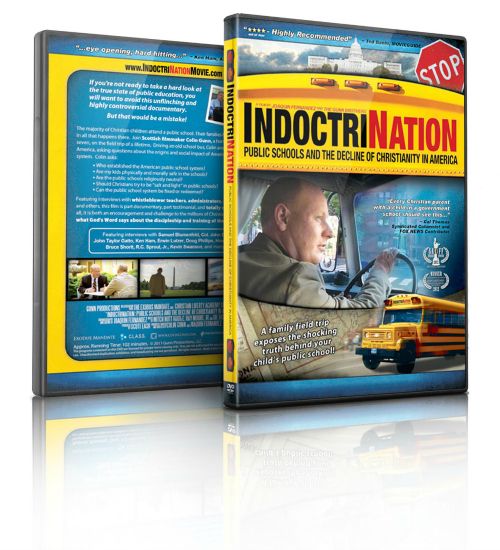
IndoctriNation (A Schoolhouse Crew Review)


When the decision to homeschool is made, it's usually a decision not made lightly and much research is put into making the right decision for our family. Many times, the current situation of public schools weighs very heavy in the decision. As a parent we watch in horror the news stories of tragedies like Sandy Hook and Columbine, cringe at the latest sex abuse scandal between a trusted teacher and their underage student or about a bullied child who commits suicide because they felt so alone in a war zone of education. I was recently asked to watch and review the IndoctriNation DVD released by Great Commission Films that addresses many of these issues and explores the argument of should we as Christians leave our children in Public Schools in order to be the "salt and light" or homeschool them instead.


IndoctriNation is a documentary produced by Gunn Brother Productions in collaboration with Joaquin Fernandez. Colin Gunn, a Scottish filmmaker
Colin Gunn
who attended public schools in Scotland and later moved to America, is a homeschooling father of eight (7 at the time of this movie) who buys a used school bus and with his wife and kids travels the US to explore the demise of government run public schools. It also goes on to discuss how public schools have lead to the decline of Christianity in America. In the process, he stops to interview various individuals such as schoolteachers, historians and a father of the Columbine tragedy in regards to their opinions on the fall of public schools.

I watched this 102 minute documentary twice: once on my own and then again with my husband and my 15 year old daughter. All three of us enjoyed the movie greatly and found it to be a very eye opening journey through the history of public schools. The video quality is very crisp and clear and the audio is very clear and subtitles are available. Audio language options include both English and Spanish.  There is not a Bluray option available and the movie can only be purchased in DVD format.

My Thoughts:


Right off the bat this movie had my attention because of the video clip of Voddie Baucham speaking of the two schools - Port Arthur and Port Neches. This struck VERY close to home for me because I went to Port Arthur schools from 2nd through 9th grade at which point my father moved us to Port Neches-Groves Independent School District because it was a “better” school with a higher median
Yup, that's me with the video camera - PNG C/0 95
income and less minorities. I did not know of the Principal Mr Baucham spoke of but I can attest that at the time I went to PNG, it was the best school in the area and is still considered to be one of the best in the State of Texas. It also had a very high percentage of students who used drugs and drank on a regular basis but everyone felt that it was okay because everyone did “wealthy drugs” as opposed to cheaper alternatives the lesser school districts around us did.

While watching IndoctriNation, I found myself agreeing with much of what was being presented  by the various interviewees and what they had to say echoed many of the same arguments I had in regards to why I wanted to homeschool my kids. From “teaching the test” to the mixed learning groups discussed by RC Murray, I've seen all of it in either my own public school education or from having a daughter who has been in public schools her entire schooling.

Most importantly, the whole discussion about sex education and access to birth control in schools really hit home. My daughter has had sex education in school every year now since her 5th grade year (she's in 10th grade). The sad thing is my daughter can tell me all of the female and male anatomy but cannot show me where more than half of the states are located on a map.  At one time,  I had to sign a piece of paper stating I was allowing her to take the class – now I have to sign if I do NOT want her to take the class. This takes my choice as the parent out of the equation because if she want to take the class without my knowing she just does not have to bring the paper home. Luckily, our school district does not pass out birth control but it's scary to know that some schools are making condoms accessible to students as young as 6 (whom hopefully at that point would only use them as nasty tasting balloons).

IndoctriNation DVD Review


Another key point that really struck home for me was in regards to the response public schools seem to have with ADHD. Mr Gunn mentions the fact that many times drugs are pushed onto students (especially boys) in order to get them to sit still in their desks. He points out the fact that we do not know the long term effect these drugs will have on our children and that the school is basically using our children as uncontrolled drug experiments. I always joke about the fact I was "ADD before it was cool" - we didn't have a name for it, we were just kids who needed to focus. We survived without drugs because our teachers took the time to engage us (most of the time I was bored with the lessons and my teachers knew how to provide extra to challenge me). I know of a family right now that have two children who are very bright children but both have been given drugs due to the fact they either talk in class or can't sit still. Both are malnourished because they come home from school and go straight to sleep and cannot stay awake to eat properly. I fear that had I not homeschooled my son, he would have been one of these drugged children in this drugged society. This is EXTREMELY frightening to me as a parent.

A few other points I took away from this movie (but don't want to delve into too much because you really should watch the movie):

1. The Department of Education does not have competition. Without competition, who keeps them in check?

2. Public schools create an environment in which Christian students are pressured to give up their Christian values.

3. Public schools create attitudes of resentment to authority.

4. Homosexual history being taught in California. I had to look that up to make sure it was true - it was.. Since when does sexual preference have ANYTHING to do with what someone accomplished?

5. I think I want to go to the Creation Museum as a field trip :)

Garrett watching the credits for IndoctriNation
Finally, the closing credits to this movie were very engaging for my kids (Hey, sometimes it's about the little things, right?). My two youngest kids did not watch the movie but they were in the room while we were watching it and at the end, the credits show the chronological order of the states visited by the IndoctriNation bus. They had fun shouting out each state as it appeared - hey, a quick geography review :)  Garrett has actually had me play just the credits a few times because he enjoys them.

What My Husband Thought:


I won't say that my husband is an atheist – he's more “on the fence” at this point so I was a bit curious what his opinion of this movie would be knowing it had a Christian bias to it. My husband enjoyed the movie a lot and thought it was very well done. He stated that “even if you are not religious, the bible should be in schools as it is great source material for teaching good morals and values”.

He said he felt sick after watching it and seeing how much things had changed since he was in school  ten years ago. He feels the additions to the curriculum such as in regards to homosexuality and Islam studies is ridiculous and fears for what will be added in the future.

He found the history of the public school system to be very interesting and believes that Mr Gunn should consider making a movie focused solely on that subject as it would be a great documentary on its own as well.

Finally, he said one of the most important lesson learned - “Don't Buy Used Buses”.. I had to pause the movie at one point while we debated whether or not the bus had a bad alternator, starter and even if it ran on gasoline or diesel. I doubt Mr Gunn would have expected that discussion from his movie.


The Final Verdict:

Colin Gunn and Joaquin Fernandez did a great job on this movie. It has a way of sneaking you into the subject material rather than just presenting you with a dry and boring documentary and I found the video to be very engaging. The interview subjects were also engaging and each added something to the discussion that if edited out would leave a gap in the presentation (a good way to judge if an interview is necessary or just fluff). Brian Rohrbough's story will tug at your heartstrings in a way that no parent ever wants to understand and will leave you in tears. I would highly recommend this movie for anyone considering homeschooling, who has small children who will be starting school soon, or to a parent who seems to think public schools are doing a great job educating their kids.  I second my husband's suggestion that Mr Gunn consider making a documentary more in depth on just the history of the public school system as I found it very interesting material and a more in depth presentation would be very interesting. 


Ride on the Magic Schoolbus.. No Thanks!!  I Think I Will Walk...


From the IndoctriNation website:  IndoctriNation won the Jubilee Award as the Best Documentary at the 2012 San Antonio Independent Christian Film Festival. Additionally, IndoctriNation was the runner up to Best of Festival, which went to the Kendrick Brothers film, Courageous.

IndoctriNation can be purchased at the movie's website for $19.95 USD for the DVD.  There is also a 372 page paperback companion book to the documentary available and can be purchased together with the DVD for $24.95 on the website. You can find IndoctriNation on Facebook, Twitter, Youtube and Vimeo.

IndoctriNation DVD Review


Thursday, February 19, 2015

Stop Comparing


I think there's a point for every homeschool parent, especially one who is within the first year or two of homeschooling their kids, when you begin to compare your kid's academic performance to where their public school peers are currently at.

It almost always happens along these lines: maybe you meet up for a playdate (or maybe just a well deserved mommy date) with a friend who has a child around the same age as your own in public schools; or maybe you're surfing around facebook and your friend posts a picture of what their kid did at school that day. Either way, it is brought to your attention that their kid practically wrote the entire Gettysburg Address unassisted while you're still trying to get your kid to stop putting crayons up their nose and not eat the playdough. 


 What usually results is that we as homeschooling parents suddenly become achievement driven when it comes to what our children accomplish because we now feel we have to meet some specific timeline or else we are not providing an adequate education for our kids.

Moms, let me tell you. At these early stages of teaching your children, DO NOT allow yourself to fall into this trap.

It's so easy to sit there and look at the benchmarks that are set out by each state that indicates what a child should learn in each grade. Those benchmark lists are long and detailed and any homeschool parent who looks at them is going to feel inadequate. You mean you haven't taught your kids all that stuff?? Guess what? Neither has your local public school. Oh, they will maybe mention it in passing in a text book or pass out a quick handout but just because it's on the list of things the school says they're teaching children doesn't necessarily mean the kids actually receive enough instruction to actually learn about it. Benchmark lists are highly misleading.

One of the wonderful things about homeschooling is that as their teacher, we're able to delve into subjects as deep as we want to with our kids. We're able to take as much time as we feel is necessary to concentrate on the material since we're not dictated by a guideline published by the state as to how much time it should take to teach your child (a child that the government officials who together decide what should be taught and how has never met). Instead we're able to change our approach on subjects when one particular approach doesn't work with our child. This means that while a public school might quickly throw information at a classroom full of children in the hopes that they might retain a small percent of it, we are able to gauge how much our child actually learns about the topic and adjust our teaching method as necessary. It also means we can take that knowledge a lot deeper than just the basic facts. When it comes to homeschooling, it really is “No Child Left Behind”. 


If I were to compare my son to my friends son who is of the same age, I would probably be pretty intimidated by the fact that their son is reading at a higher level then my son is. At least, that is how it would look on the surface. The difference is one child (the public school child) was forced to memorize “sight words” in both kindergarten and first grade. When those words are used in their reading, they read very well. However, when they come to words a bit more difficult that were not on their sight word list, they draw a blank. My son, however, is learning phonics and blends rather than sight words route. He might not read the sight words as well as my friend's child but when he comes to a harder word he is able to sound out the word and eventually figure the word out. As he continues to do this, his reading skill improves and he'll eventually surpass his public school peers (and actually, he's close to doing so). If I were to fall into the trap of comparing their performance, I would probably quickly get discouraged and think that my method was the wrong one and either switch to sight word recognition to get him “caught up” or think my homeschooling was a complete failure and put him in public schools. 


The truth is that every child is different. Even in a home with multiple children who are being homeschooled, each child has their own individual learning style and tempo. My son is a very visual and hands on type of learner who excels at science and math. However, he is hates reading and tries to cut corners by guessing a word (usually wrongly) in order to skip actually reading. My daughter, however, loves reading and is reading on a much higher level then her peers. However, she dislikes math and tends to cut corners with it. Both children are the same grade and are taught the same things in the same manner but because they are individuals who think and act differently, they excel at different things. Using the same example of my son and my friends son, if I were to compare my son to his sister, his sister would be well ahead of him in reading, even though they were taught the same way. The difference between my educating my kids and the public school system educating my children, however, is that I know my son is struggling with reading and can work with him until he gets it where as many times, children are indeed left behind and are graduating high school practically illiterate. 

California High School Exit Exam


My teenage daughter took the California High School Exit Examination (CAHSEE) test this month. She attends public schools because that's what her father demanded so I wasn't able to homeschool her. Currently, she is in 10th grade. Before a student graduates from high school, they are given 8 opportunities to pass the CAHSEE test so they can earn a diploma. I was curious as to why a high school exit exam would be given in 10th grade, when 2.5 more years of school instruction are needed before graduation. Here's what I found about the CAHSEE test on their website:

"The primary purpose of the CAHSEE is to make sure that students who graduate from high school can show that they are performing at grade level on California’s content standards. The content standards on the CAHSEE include reading, writing, and mathematics. Standards describe what students should know and be able to do at each grade level from kindergarten through grade twelve."


The next thing that caught my eye was this:

"The exam consists of two parts. The first part includes English–language arts (reading and writing) content standards through grade ten. The other part of the CAHSEE addresses California’s mathematics content standards in grades six and seven."
This means that the requirements to graduate high school is 7th grade math. As a homeschool parent, I plan on teaching my kids math concepts well beyond those taught in 6th and 7th grade. This also means that basically everything your child needs to know about math in order to graduate from high school (at least in the State of California) is learned by 7th grade making high school instruction in mathematics unnecessary. However, in February 2013 when the test was administered to to grades 10-12th only 73% passed the math portion. Even more disappointing was that only 69% of those students passed the English/Reading Portion.   Don't forget, they have 8 tries to pass the test before they graduate and many end up taking it 8 times and still do not pass.
In truth, this is what you're comparing yourself to.. 
Don't you agree you can do so much better than that in the longrun?
Just Stop 
Slow it down and take your time, even if it takes much longer than what the benchmark guidelines per grade dictate. Your kids will eventually get it if you are diligent and work with them; it doesn't matter if it takes 2 months or 2 years as long as they get it.


And if you need any more convincing, keep these statistics in mind (taken from the National Home EducationResearch Institute's website):

  • The home-educated typically score 15 to 30 percentile points above public-school students on standardized academic achievement tests. (The public school average is the 50th percentile; scores range from 1 to 99.)

  • Homeschool students score above average on achievement tests regardless of their parents’ level of formal education or their family’s household income.

  • Whether homeschool parents were ever certified teachers is not related to their children’s academic achievement.

  • Degree of state control and regulation of homeschooling is not related to academic achievement.

  • Home-educated students typically score above average on the SAT and ACT tests that colleges consider for admissions.

  • Homeschool students are increasingly being actively recruited by colleges

Disclosure

Disclosure
Related Posts Plugin for WordPress, Blogger...