Showing posts with label Hands-on history. Show all posts

Wednesday, July 7, 2021

Colonial Life (A Homeschool Crew Review)

Disclosure: I received this complimentary product through the Homeschool Review Crew


This year for our history curriculum, the kids will be learning US History from early colonization to 1850.  Because of this, we were super thrilled to have the opportunity to review the Time Travelers: Colonial Life history study, part of the Time Travelers U.S. History Studies  for Grades 3-8th offered by Home School in the Woods. This unit is the perfect supplement to our upcoming history curriculum. Offering a vast array of  interactive, hands-on unit studies, lap books, Time Traveler series and more, Home School in the Woods offers a unique style curriculum that brings history to life.

HSitW-LOGO-website_360x-2

HSITW1If you are unfamiliar with history studies from Home School in the Woods, they are period focused studies that have multiple components to help students learn.  Through the course of the study,  students are presented a wide variety of activities: notebooking, lapbooking, crafts, copywork, creative writing, cooking, maps, timelines and more.   This particular unit study over the Colonial period of US History contains various activities for the kids to complete as they learn about how America's Colonies Began,  The Colonial Home, Clothing, Food, Family Life, School, Faith in the Colonies, Villages & Cities, Health & Medicine, Artisans, Crime & Punishment, Plantations & Slavery, Pleasures & Pastimes, and Holidays!

The Time Travelers Colonial Life study is a digital file that is completely contained on your computer.  Once purchased, a user downloads a ZIP file containing all the files for the study which is then extracted to their computer. This installs all the files necessary and means once installed the unit study can be accessed and printed without the need for internet access.   Once installed, the unit study is loaded up as an easy to use webpage which gives quick access to all the files needed for each lesson.  Colonial Life contains 25 lessons that can be done over the course of 5-10 weeks.   Every 5th Lesson is considered a "Craft Day" which allows for the student to focus on completing projects for the previous 4 lessons as well as to concentrate and review vocabulary  and important facts/dates learned before moving on.

HSITW2

Each lesson contains Text Pages and Project pages. Each lesson begins with a briefly written lesson written in an interesting, story style format. This format is reminiscent of "living storybooks" or a Charlotte Mason style format.

HSITW3

The second component of the unit is the  lesson projects. These follow the text pages and contain activity choices to reinforce the topic just discussed.   These Project Pages tell what activities will be completed for the lesson including which pages will need to be printed out.  They also contain step by step instructions for completing each project.  A Photo Gallery is also included also gives a visual aid of the final outcome of the projects and placement of components for the lapbook to help assist with the projects.

HSITW4

We have been using this unit study not so much as a curriculum this time around, but just as a fun way to continue to learn while we are adjusting to our move and enjoying the summer. As the kids have always enjoyed studies from Home School in the Woods, this has been a great option for having them do something educational without it seeming “too educational”.. To them, it’s more fun than work.

Without a doubt, the favorite lesson so far has been about Colonial food.  Every Home School in the Woods unit we have done has always included a food unit, where the kids make a recipe book filled with recipes from the area or time period they are studying.  The Colonial Times unit is no different. 

food1food2

With recipes in hand, Ashleigh decided she wanted to cook the Chicken Pie and Johnny Cake found in the recipe book.  We printed out a second copy of the recipe so she wouldn’t have to use the recipe book she worked so hard on coloring for her lapbook and she got to work while Mom supervised.

IMG_20210621_162552_401

IMG_20210621_163324_603

IMG_20210621_163748_235

IMG_20210621_164156_974

IMG_20210621_172327_054IMG_20210621_171633_278

From start to finish, she was able to follow the directions very easily and was able to produce a meal that everyone really enjoyed and deemed as a repeater. 

I really look forward to restarting this product next month when we begin our school year in earnest as I think this will fit in perfectly with our upcoming curriculum.

I've yet to find a product from Home School in the Woods that we haven't loved and this study about the Colonial Life is no different.  And Home School in the Woods has recently added some new Biblical history timelines to their Individual Timeline Sets that include Timeline Set: Creation to Christ  (Beginning - 100 AD)  and Timeline Set: Resurrection to Revolution (0 -1799 AD).  Some of the members of the Crew have been reviewing these Timeline Sets with their families these last few weeks, so be sure to read their reviews.  You can also find more detailed information about this product by reading Home School in the Woods blog .

#americanhistorycurriculum #lapbooks #lapbooking #timetravelers

Connect with Home School in the Woods on social media

Website | FacebookTwitter  | Instagram | Pinterest  | YouTube
 
Members of the Crew have been reviewing a wide selection of curriculum offerings from Home School in the Woods.  Click the banner below to read their reviews today. 
Hands On History with Homeschool in the Woods

Thursday, March 26, 2020

Home School In The Woods (A Homeschool Crew Review)

Disclaimer: I received a FREE copy of this product through the HOMESCHOOL REVIEW CREW in exchange for my honest review. I was not required to write a positive review nor was I compensated in any other way.


In the past, the kids and I have used selections from the Project Passport Ancient History series from Home School in the Woods.  However, for the last few weeks, the kids and I have been learning about American History and the Early 19th Century study from the Time Travelers U.S. History Studies .

If you are unfamiliar with history studies from Home School in the Woods, they are period focused studies that have multiple components to help students learn.  Through the course of the study,  students are presented a wide variety of activities: notebooking, lapbooking, crafts, copywork, creative writing, cooking, maps, timelines and more.   This particular unit study over the Early 19th Century contains 35 various activities for the kids to complete as they learn about the invention of Morse code, the Erie Canal, the Louisiana Purchase, the California Gold Rush, the Alamo and more.

 The Time Travelers U.S. History study is a digital file that is completely contained on your computer.  Once purchased, a user downloads a ZIP file containing all the files for the study which is then extracted to their computer. This installs all the files necessary and means once installed the unit study can be accessed and printed without the need for internet access.   Once installed, the unit study is loaded up as an easy to use webpage which gives quick access to all the files needed for each lesson.   Early 19th Settlers contains 25 lessons that can be done over the course of 5-10 weeks.   Every 5th Lesson is considered a "Craft Day" which allows for the student to focus on completing projects for the previous 4 lessons as well as to concentrate and review vocabulary  and important facts/dates learned before moving on.


Each lesson contains Text Pages and Project pages. Each lesson begins with a briefly written lesson written in an interesting, story style format. This format is reminiscent of "living storybooks" or a Charlotte Mason style format.
The second component of the unit is the  lesson projects. These follow the text pages and contain activity choices to reinforce the topic just discussed.   These Project Pages tell what activities will be completed for the lesson including which pages will need to be printed out.  They also contain step by step instructions for completing each project.  A Photo Gallery is also included also gives a visual aid of the final outcome of the projects and placement of components for the lapbook to help assist with the projects.

We have been using the study as more of an enrichment curriculum for the last few weeks to go along with our current history curriculum.  Because of this, we have been shooting to complete 2 lessons each week and using the 5th lesson (Craft Day) to catch up.

For each kid, we are using a 1.5 inch binder with a pocket in the front cover for them to keep the components together.  They can then tuck their lapbook in the pocket and all other work is hole punched and kept together inside.  The study has printable binder covers as well as a printable strip for the spine of the binder that's available in both black and white or color.

Garrett's Binder.

The kids keep their timelines, writing samples,the song book which contains the lyrics of various songs important to the time period and the Westward Weekly, which is the creative writing project that allows kids to paraphrase what they are learning as if they are a reporter writing for a 19th century newspaper. 


The kids also keep a ziplock bag with their Factfile cards in the back of their binder where they can keep them together and organized for easy access.


Here's a close up of a few of the Factfile cards..


The lapbook portion of the unit is filled with small mini books, popups and more that help reinforce the material learned in each lesson.   We used different color folders for our lapbooks: blue for Ashleigh and red for Garrett.  The cover features a panhandler from the California Gold rush. We even used some gold leaf for the gold in the pan on our covers.


hi

Inside the lapbook, the kids keep their activities such as minibooks and popup folders.  The folder is designed to have four surfaces inside in addition to a center map. 


The map sits in the very center of the lapbook.  Using clear overlays, the kids create a map with multiple levels showing things such as the growth of the United States as it expands westward and major trails used to travel throughout the west. 


 Other activities include copy work using the McGuffy's Eclectic Third Reader.  We've really enjoyed this portion of the activities as it has given Garrett an opportunity to improve his handwriting (he hates writing).

We've also enjoyed the Westward Weekly writing assignments.  These are creative writing exercises where the kids get to summarize what they have learned from the lesson as if they are writing for a newspaper publication. 


Ashleigh's favorite portion so far has been the hands on crafts.  The projects created with this unit study are things that the student can actually keep and use, keepsakes and souvenirs if you will, from their learning.  So far, we have only made the Field book, which Ashleigh is really looking forward to using in her nature studies.  Unfortunately, we had to skip making the coon skin cap (using fake fur of course) for now because we have been completely locked down for a few weeks now and was not able go to the fabric store.  However, we do plan to return to that project as I am ordering the materials for that as well as a quilt project to be completed in lesson 16 as well as the materials for the Wheat weaving and the Serape Coaster  which will involve the kids creating a loom and shuttle to weave yarn much the same way Mexican and Native Americans in the 19th century did.

Ashleigh and her field guide
I've yet to find a product from Home School in the Woods that we haven't loved and this study about the 19th Century is no different.  And with the upcoming 2020 Presidential elections quickly approaching, I have a feeling we will find ourselves purchasing and using the U.S. Elections Lap-Pak created for grades 3rd-8th to help both Ashleigh and Garrett to learn and understand how our election process works.  Some of the members of the Crew have been reviewing this Lap-Pak with their families these last few weeks, so be sure to read their reviews.  You can also find more detailed information about this product by reading Home School in the Woods blog .

#hsreviews #HSitW #homeschoolinthewoods


For more information about Home School in the Woods and their many

Facebook: https://www.facebook.com/homeschoolinthewoods/
Twitter: https://twitter.com/HSintheWoods
Instagram: https://www.instagram.com/homeschoolinthewoods/
Pinterest: https://www.pinterest.com/hsinthewoods/boards/


Members of the Crew were invited to review their choice of twenty different products offered by Home School in the Woods targeting various grade ranges and periods of history. Be sure to click the banner below to read their reviews today.
Home School in the Woods Collections - Lap-pak, Timeline Figures, History Studies & Activity-Pak {Home School in the Woods Reviews}

Wednesday, August 1, 2018

Project Passport: Ancient Egypt (A Homeschool Crew Review)


A few weeks ago, the kids and I began tackling the Project Passport: Ancient Egypt unit study from Home School in the Woods.  If you will recall earlier this year, we did a review on the folder game "Tomb Dash!" which was one of the stand-alone Á La Carte  products from Home School in the Woods.  The kids didn't do that well with the trivia that went along with the game when we reviewed it back in March.  The folder game as well as the trivia questions are part of the larger Ancient Egypt study and the kids (especially Ashleigh) wanted to do this particular unit because they want to be able to beat their older sister at "Tomb Dash!".  As luck would have it, we were given the opportunity to review it :)


The Ancient Egypt study, like each of the studies in the Project Passport World History Studies, is designed to take your student on a fully immersive trip through various "stops".  Each of these stops focuses on one particular aspect of Egyptian history such as the hierarchy of Egyptian government, Egyptian weapons and warfare, the Pharaohs and their dynasties, everyday life, culture and religious beliefs of the time.
The Egyptian study contains 25 individual stops.  At each of these stops, a short narration is provided
that introduces the student to the material for the topic.  This narration, called the "Guide Book Text", is between 2-4 pages, depending on the topic and is written like a script that a travel guide would give to an audience.  While very factual, it's written in an entertaining manner instead of in a textbook format.   After listening to the reading for the stop, students then work on different activities that reinforce what they learned about in the text.  A few stops even have Audio Tours where students listen to an included MP3 file where a "field guild" describes events or locations as if an actual visit was taking place.

In addition to the text and activities, an included Travel Itinerary in included for each stop and contains the instructions for completing each of the projects .   From a teacher standpoint, this is one of my favorite things about this curriculum as I can print this out and use it as a check off to make sure that I have covered everything necessary. The itinerary lets me know  when the kids need to add a location on their maps or add an event to their timeline, as well as what needs to be printed out for the stop's activities. 


When using the digital downloadable version of the Project Passport, the entire curriculum is downloaded directly into a file on the computer.  A file entitled "Start.html" allows the user to click on the link and have the entire curriculum load up as a webpage in your default browser.  The Digital Edition is entirely browser based - once the files are downloaded you do not have to have an internet connection as all files are located on your computer.   Each of these files are saved as PDF's on your computer and are extremely easy to access and print out for binders.  The entire file for the Ancient Egypt study only took up 323 MB of hard drive space.  However, for those who prefer a physical copy of the unit study, Home School in the Woods does provide the option of ordering a physical CD. 


One of the major highlights of using this particular study unit is that your student will end up with a binder of projects that resembled a scrapbook project more than the typical lapbook often seen with a more hands on project, making it something that students will cherish more than other projects.  However, there is also a lapbook component for those who really enjoy doing them. The drawback to this is this also means that your printer will get a workout as there are many components that have to be printed for each stop, using various different paper if one wishes to really make this a unique project.  It should also be taken into account that the volume of printing is doubled when using this unit study with multiple students, as each one is going to want to make their own projects.  Some projects also use specialty materials, such as crafting foam  Scissors and glue (or glue sticks) are an absolute necessity.  There are so many wonderful projects your student will make while learning about Ancient Egypt.  Students will remember what a Nemes headdress or a Hyksos chariot much easier when they make their own. 


How We Used It:

The Project Passport studies have always been a huge hit in our household so everyone was really excited when they found out we were going to be reviewing the Ancient Egypt study.  We had gone earlier this year to see the King Tut display here in Los Angeles which whet everyone's whistle for all things pyramids and mummies.


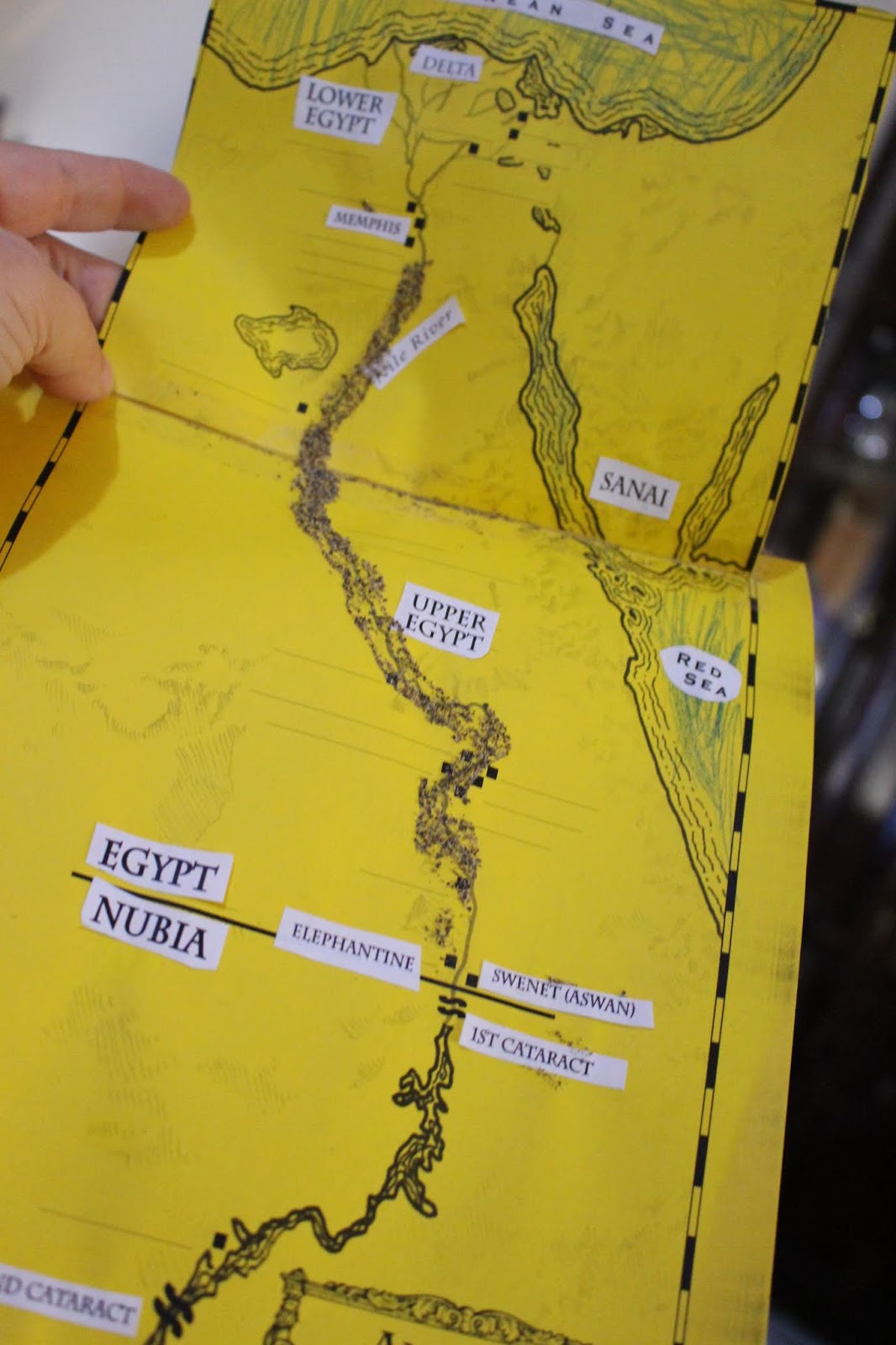
The kids are use to doing map work that goes along with any Project Passport study.  However, they had a bit of a surprise this time when they were learning about the rich, fertile black soil that is distributed along the banks of the Nile river. They thought I lost my mind when I told them to put glue along the River and then sprinkle black pepper on their map to represent the soil.   This has been a laugh for them every time they do map work and was a nice unexpected touch.


Another aspect of Project Passport that the kids have come to expect is the "Snapshot Moments in History".  This is a visual timeline that the kids fill out with each lesson so that they can have a visual representation of how each event they learn about falls.


This is an activity that the kids actually share, rather than each having their own timeline.  They take turns finding the event and gluing the graphic into the timeline.  We decided to do it this way rather than each kids having their own because it makes Garrett actually read and find the proper place rather than just copying his sister ;)


Ashleigh's favorite project so far was the activity about Egyptian fashion where she was able to color and design her own paper dolls.  She even created articles of clothing using colored tissue paper.  She also colored the men's fashions using the gold and blue color scheme that she remembered from our King Tut visit.

One thing that is always popular with the kids when we work through a Project Passport study is the day we cook a meal using the included recipes.  Now that the kids are a bit older and are more familiar with the kitchen, they helped picked the menu from the recipes supplied and then had their hand at cooking up some Egyptian food.  While I worked on the Aish Baladi (bread) and Ful Medames (beans), the kids worked on the Cucumber Chickpea salad and the Kofta (meat).  A bit of hummus to spread on the Aish Baladi and we had a really nice meal.  The bread was very popular with everyone, especially considering it was a wheat bead and was still soft, and it has already been requested for future meals. My husband really liked the salad and wants that as a repeat as well.   There are other recipes included and we will probably revisit this particular project to whip up a few of the other recipes.


Another thing that was really neat for us for this particular study was that we were able to take the things that we wear learning and then put it with the visit that we had to the King Tut display.  For example, when we went to the display, we were able to see many of the items that were found in King Tut's tomb.  However, beyond just a general description of what the item was there wasn't any information that explained anything.  Two of these items that we were able to see was a bed as well as some head rests.  They were not displayed together, nor were they even in the same areas of the display.

King Tut's Bed
King Tut's Headrest
While we thought the bed was really neat when we saw it, we didn't put these two items together. However, when we were working on Stop #3, it talked about the fact that the beds were elevated at one end and that rather than a pillow, they used a headrest.  Prior to reading this, we thought that the board on the bed was a headboard but it was a foot board with the head elevated.  We all failed to put the two items together and we also failed to realize that the head of the bed was elevated.


Another item that we saw that we were able to immediately able to coincide with the study was the discussion about Egyptian fashion and the wearing of Pectorals. One of the activities for in Stop #3 was "Dress Like an Egyptian (Boy)" which had directions to create an Egyptian outfit which included a Pectoral necklace.

Dress Like an Egyptian (Boy) Crafts for Stop #3
My kids IMMEDIATELY recognized the pectoral as being the solar falcon pectoral that we saw at the Tut display.  The kids can't wait to make this (and the dress like an Egyptian girl project) but we had to skip it at the time we covered it because we couldn't get to town to get the foam needed for the girls craft. 


Even more than just the fashions, the kids have found themselves recognizing things that they have seen from the Tut exhibit as they are covered in the Study.   In Step #4, the kids learned how to play the game Senet.   This really made their day, because they saw a Senet game at the museum and they asked me how to it was played but I honestly didn't know.  And they were able to create their own senet game and play on their own.

King Tut's Senet set

Home School in the Woods Senet Game
In Stop #5, the kids have been learning about the process of mummification and the use of Canopic jars.  On Friday they will be making a craft where they design their own canopic jars out of modeling clay and dixie cups and while I doubt ours will look anything like Tut's, it was cool that they have seen the stopper and coffinette for Tut's canopic jars.


While we still have a long way before we get to Stop #21, I am looking forward to reaching it with the kids because that Stop focuses on Tutankhaten.  But just having the experience of seeing the various artifacts from the Ancient Egyptian time period and then learning more about those items with this Project Passport study has been a very neat experience for the kids.

In the past, we have kept all our activities and map work in a three ring binder.  However, this time
around, the kids have been using the lapbook variation.  Directions for assembly is included with the digital download of the study.  We have really enjoyed this variation rather than the binder because the kids can keep all their work in their own file folder and they can also glue the lapbook components into the folder to keep track of them.  They each colored their own cover picture so they can quickly recognize their own fold and keep track of their own work rather than Mom keeping track of the work and passing it back out to the kids. 

This curriculum can definitely be used as a stand alone curriculum to study a particular time period, but it's very easy to add supplemental materials to the lessons to expand even further and reinforce what is being learned.    Books and videos can easily be added in with the lessons with each "Stop" and Home School in the Woods also provides a list of resources that offer suggestions on materials that can help to supplement the unit study.  It covers a large amount of material while keeping the journey fun and interesting while they learn.  I know that when we reach Stop #24 and the kids revisit "Tomb Dash!", they will do much better than they had done earlier this year (and will most likely beat their older sister as well!!). 

#hsreviews #historystudies #worldhistory #americanhistory #historytimelines #historycurriculum
 
Home School in the Woods offers a very wide variety of history study units, from Ancient history, US History, Elections, and even Geography.  To find out more information, visit their website. You can can also find Home School in the Woods at the following social media sites:

Facebook: https://www.facebook.com/homeschoolinthewoods
Twitter: https://twitter.com/HSintheWoods
G+: https://plus.google.com/+Homeschoolinthewoods
Pinterest: https://www.pinterest.com/hsinthewoods/


Members of the Crew were offered the opportunity to review many of the various products Home School in the Woods offers.  In addition to the various Project Passport World History Studies offerings, you can read reviews for Hands-on History Lap-Paks, Time Travelers American History,
Hands-on History Activity-Paks, Hands-on History Activity Studies, and many of the À La Carte Timelines.  Be sure to click the banner below and read the rest of the reviews to find a product to start today :)


Also, Home School in the Woods has recently released a brand new Project Passport study, the Ancient Rome pack.  Topics include: kings and legends of early Rome, the Roman Republic, the rise and fall of an Empire, everyday life, business, law, philosophy, education, oration, literature, science, medicine, arts, architecture, transportation, religion, warfare, emperors, the Pax Romana, invasions, the beginnings of Christianity, and much more! Suggested grades: 3-8
Hands-on-History, Project Passport, À La Carte Timelines and Time Travelers {Home School in the Woods Reviews}


Disclosure

Disclosure
Related Posts Plugin for WordPress, Blogger...