Showing posts with label literature. Show all posts

Monday, October 7, 2019

Progeny Press (A Homeschool Crew Review)


Progeny Press is a company that we have become very familiar with in our household over the last few years, as they are known for providing high quality literature guides for a wide variety of classical literature for all grade levels.  Recently, we were given the opportunity to review two more study guides in our classroom - Little House on the Prairie Study Guide  and Shadow Spinner Study Guide .  


Our review will mostly focused on the study guide for Little House on the Prairie because that was the guide that we worked with first and was able to complete the entire study from start to finish.  However, we began working on the Shadow Spinner study guide after completion of the first guide and have gotten a few weeks into it at this point as well. 

Both of these guides were given to us as digital download PDF files.  Each study guide consisted of two files - the interactive study guide itself as well as a separate answer key.  A physical copy of the guide as well as a physical CD of the file is also available for purchase from the Progeny Press website.


About Progeny Press

Progeny Press is a publishing company who offers E-guides for literature with a Christian perspective. Offering guides for reading levels from early elementary through high school, each of the Progeny Press guides are designed to help students to better understand the story they are reading as well as to recognize the themes presented by the author. The units contain study questions as well as recommended map work, research ideas, vocabulary lessons, and even Biblical verses that tie into the story.

However, what makes Progeny Press different from other literature study guides is that Progeny Press uses Biblical teachings, backed with scripture, to tie the story into practical lessons. While many books contain content or beliefs that do not align with Christian beliefs, Progeny Press guides direct students to instead study what God says about such things so they will be better prepared and strong in their faith when they face such behavior, language, and philosophy in life. 


Using Progeny Press in our Homeschool

We were offered two different literature study guides to use in our school.  We selected Little House on the Prairie Study Guide and Shadow Spinner Study Guide.  Both of these guides are listed as being "Interactive" files, which means that they can be opened using Adobe Reader on a computer and the student has the ability to enter their answers directly into the file and save their work to the computer, or the teacher can choose to instead print out the study guide as a handout for the student to write out their work.  For this review, we decided to try both methods - we printed out the study guide for Little House on the Prairie and for Shadow Spinner, I decided to allow Garrett to type out his answers and print out a hard copy of his work once he finished each section.


Ashleigh's Notebook with copies of both of her study guides inside

We immediately started with the Little House on the Prairie Study Guide.  This is a 62 page PDF guide to be used while reading the book of the same name by Laura Ingalls Wilder and is designed to be used with grades 4th-6th.

Each week, the guide would recommend a set amount of reading for the students to complete.  We read the book selections aloud for our morning time each morning.  What typically worked best for us during this particular guide was to read 2 chapters a day for three days (the reading for Little House on the Prairie typically required 5-6 chapters a week) and then for the last two days of the week we would work on the questions together during our discussion time.  Suggested activities were then scattered throughout the lessons  where they would fit in best  - for example, listening to the songs Pa would sing at night worked well while reading that portion of the chapter.

Luckily Picket doesn't understand English and our reading about stewed Jack Rabbit with dumplings and gravy.

Following the suggested reading, the study guide followed a pretty general format.  The first activity included some sort of vocabulary exercise, such as determining a word's meaning based on the context it was used in or looking up the actual definition.   Vocabulary exercises were followed by a series of questions that progressively require more from the student as they completed them.  The first set are simple comprehension questions that could be answered straight from the reading.  A second set of questions then asked students to use deductive reasoning skills to answer questions that weren't as straight forward as the comprehension questions - such as what they think a character might have meant in saying something in particular or comparing their own lives to that of the characters. A final third set of questions - the "Dig Deeper" section of questions - uses situations found in the book and asks the student to read a passage of scripture and find a correlation between the two.


In addition to vocabulary and questions, there are also suggested projects and activities that can be done to help with enrichment.   This section offers a wide variety of activities that fall into a large array of categories.  One activity gave a recipe to make cornbread from scratch (something we do often in our home) while another activity had the children make a list of Charities that they can make a gift to this holiday season.  A few activities that we included with our reading was using Lincoln Logs to build a log cabin, listening to recordings of wolves howling at night, and listening to recordings of fiddle music of some of the songs mentioned in the reading. 


Garrett's Log Cabin out of Lincoln Logs

Listening to some of the fiddle selections that Pa played in the book. 

Working on questions following a chapter in the book

After finishing The Little House on the Prairie, we then began reading the book Shadow Spinner by Susan Fletcher.  The PDF study guide for this selection is written for grades 5th-8th and is 103 pages in length (89 pages for the guide and the 14 page answer key).


As this study guide is for middle school students and requires more writing then the previous study guide,  I opted for Ashleigh to use a printed version that she could write on while I allowed Garrett to work on the computer to type his answers.   The PDF allows for Garrett to fill in the answers using a reader program, save his work and then we can print out his work and put it in his binder.  


Garrett gets rather frustrated with writing, especially with longer writing, so being able to type has been a blessing for him.  Granted, I do catch him using shortcuts in order to do his definitions, but he's happily completing the work. 


This particular study goes deeper into studying literary tools that are used by the writer throughout the book, such as foreshadowing, juxtaposition, alliterations and such.  Where as the Little House on the Prairie study had various activities, because this study is for older grades, it focuses more on learning these literary tools in addition to vocabulary and comprehension questions.


We have always enjoyed using Progeny Press study guides in the past and the older the kids get, the more they seem to appreciate these guides.  I especially enjoy the large selection of guides that are offered, especially for older grades, as well as the Christian perspective the guides give (the Dig Deeper section really provides an opportunity for students to see how scripture gives an understanding for our lives beyond the pages of the Bible).  


#hsreviews #literature #homeschool #unitstudies #reading #english #criticalthinking #ilovebooks #progenypress

For more information about Progeny Press and their various literary guide offerings in addition to the two guides that we reviewed, be sure to visit their website.  You can also find them on the following social media sites:


Members of the Review Crew were given their choices of four study guides, one for each level of schooling (Early Elementary, Late Elementary, Middle School and High School).  Be sure to click on the banner below for the opportunity to read their reviews today.
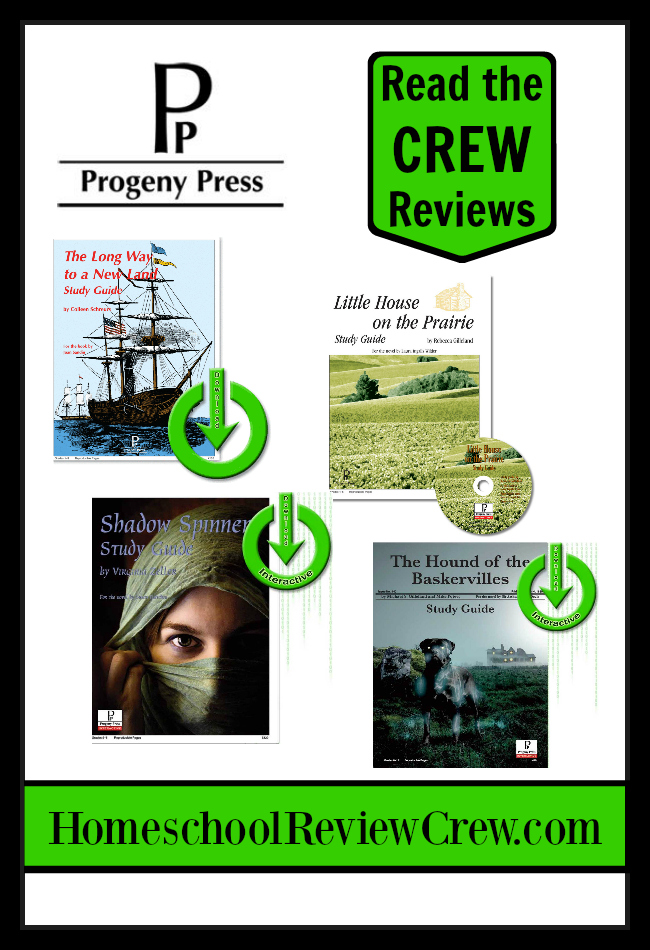
Study Guides for Literature {Progeny Press Reviews}


Wednesday, July 18, 2018

Progeny Press (A Homeschool Crew Review)


When I was in school, one of my favorite courses was my English classes. Even in college, I enjoyed my college literature classes because it was in those classes that I was given the opportunity to read and enjoy classic literature.  However, last year, my oldest daughter graduated from high school.  In the course of her schooling, I was very disappointed to find that she didn't really read much as far as classic literature.  No Victor Hugo, Leo Tolstoy, Jack London, Ernest Hemingway, Nathaniel Hawthorne, Bronte sisters, Mark Twain, or even William Shakespeare, which were required reading when I was in school.

One of the things I enjoy most with homeschooling is that I can have control over what books my younger kids have to read through their school years.  I want them to learn to read, appreciate and even love classical literature.  Progeny Press allow me as a parent to go well beyond just reading the story with them. Using their study guides to dive deeper into the story using questions and activities, students are able to develop critical thinking skills, interpretation skills and go beyond just the surface of the story.  For the last few weeks, the kids have been using The Green Book - eGuide from Progeny Press to better understand The Green Book by Jill Patton Walsh.

About Progeny Press

Progeny Press is a publishing company who offers E-guides for literature with a Christian perspective. Offering guides for reading levels from early elementary through high school, each of the Progeny Press guides are designed to help students to better understand the story they are reading as well as to recognize the themes presented by the author. The units contain study questions as well as recommended map work, research ideas, vocabulary lessons, and even Biblical verses that tie into the story.

However, what makes Progeny Press different from other literature study guides is that Progeny Press uses Biblical teachings, backed with scripture, to tie the story into practical lessons. While many books contain content or beliefs that do not align with Christian beliefs, Progeny Press guides direct students to instead study what God says about such things so they will be better prepared and strong in their faith when they face such behavior, language, and philosophy in life. 


How We Used It


We reviewed the 57 page  downloadable E-guide version of The Green Book study guide by Rebecca Gilleland as well as a 6 page Answer Key that accompanies the study guide. The chapter book must be purchased separately from the study unit but it is offered for sale on the Progeny Press website. This particular study unit is recommended for Upper Elementary and is recommended to be used for grades 3rd-5th.  I used it with Ash and Garrett as we read through the book together.

The E-Guide is broken down with questions and activities to use with each chapter of the book.  The activities include vocabulary exercises, word searches, crossword puzzles, venn diagrams, and even a mystery message activities that the kids really liked. At the end of each chapter of the E-Guide is various suggestions on projects and activities to do after completion of the book that tie in arts and crafts, cooking and oral reports.  Utilizing these activities helps to tie other subjects such as Science and physical activities into the study.  (The kids especially enjoyed learning about Fire Opals).


I hate saying it, but the kids and I didn't care for the book itself.  Luckily, I'm not reviewing the book.  The study guide, on the other hand, is very nice and we enjoyed all the various activities.  I especially liked the vocabulary activities where the kids had to take a guess at a words meaning based on the context it was used in the story.  I enjoyed listening to the guesses that the kids made and seeing how correct they were.  For example:  the kids were introduced to the word "treacle" from the text "But what he showed us[...]looked a funny hue, as though someone had brushed it over with a layer of treacle."  This was a word the kids had never heard before.   Ashleigh guessed it meant a blanket  while Garrett thought it had something to do with a tree.  Now, they both know that treacle is the British term for molasses.  The study guide has plenty of vocabulary building exercises like that. 


I've used other Progeny Press Study Guides in the past and I have always found them to be well written and thoroughly cover the books main topics.  Each guide really does well to expand beyond just reading the book but also understanding the underlying elements.  But mostly, I am glad that when it comes time for my kids to read Huckleberry Finn, Beowulf, Julius Caesar or Jane Eyre, these guides will be waiting to help them develop a true understanding of Classic Literature.


For more information about Progeny Press and their large selection of literature study guides, visit their website. You can also find them on the following social media platforms:


New Study Guides for Literature From a Christian Perspective {Progeny Press Reviews}


Wednesday, June 15, 2016

Progeny Press (A Schoolhouse Crew Review)


Recently, the kids and I went to the Renaissance Festival and like any typical kids, they fell in love the ideas of Kings, Princesses, Castles and Knights on Horses.   So when we were given the opportunity to read the book The Minstrel in the Tower by Gloria Skurzynski with the kids and then use and review The Minstrel in the Tower E-Guide by Progeny Press, I knew the kids would be pretty excited.  Granted, the Medieval times were a bit before the Renaissance period, but I knew the kids would still be pretty excited about it.  With E-Guide in hand, the kids and I traveled back to 1195 to France following the Crusades and to learn about Alice and Roger and their quest to find their Uncle. 

About Progeny Press


Progeny Press is a publishing company who offers E-guides for literature with a Christian perspective. Offering guides for reading levels from early elementary through high school, each of the Progeny Press guides are designed to help students to better understand the story they are reading as well as to recognize the themes presented by the author. The units contain study questions as well as recommended map work, research ideas, vocabulary lessons, and even Biblical verses that tie into the story.


How We Used It

We reviewed the 47 page  downloadable E-guide version of the Minstrel in the Tower study unit by Rebecca Gilleland. The chapter book must be purchased separately from the study unit but are offered for sale on the Progeny Press website. This particular study unit is recommended for Lower Elementary grade levels between Kindergarten through 3rd grade.  I used it with Ash and Garrett as we read through the book together.

The E-Guide is broken down with questions and activities to use with each chapter of the book. At the end of the E-Guide is various suggestions on projects and activities to do after completion of the book that tie in arts and crafts, cooking and oral reports .

Since Garrett balks at the idea of any amount of writing, I found the best way for us to use the E-Guide was to print out a master copy for myself that I could use to ask the comprehension questions and we could discuss the answers as a group.  The individual activities such as the word find puzzles and I printed out for the both of them to work on their own.  As this is a downloadable product, Progeny Press's license does allow for parents to reproduce pages for use in their own classroom and home so I was able to print out copies for both of them.

Garrett works on a vocabulary exercise

The questions are absolutely wonderful and made for a great way to gauge the kids comprehension of the story as well as a platform to help the kids dig deeper into various story elements and ideas presented. There were also some really great activities for helping build vocabulary.  The last few pages of the E-Guide provide additional resources that coincide with the study as well as the answer key for the activities included.

As Progeny Press offers literature studies E-Guides from a Christian perspective, different elements of the story are also tied in with corresponding Biblical verses that help children understand not just the story but the scripture better.  For example, at the beginning of the story, the mother asks the son to do something but that the son is unsure about.  At this point in the study the children read and discussed Ephesians 6:2 and what it means for children to obey their mother and father.   Later in another chapter, when discussing  overcoming fear, we read and discussed Psalms 23:4, Isaiah 41:10 and Psalms 118:14 and talked about how God is always with us to provide strength and never abandons us.   All verses are presented in the NIV format.

Not only did we enjoy the E-Guide but we also used a few of the suggestions for outside resources and read about Francis of Assisi whom the kids found very interesting.   Progeny Press puts together some really wonderful E-Guides and they are a company that I know that I can trust for quality materials for our various literature units.


Find out more about Progeny Press and the various Literature E-Guides they offer by visiting their website or any of their social media sites.


    Twitter: twitter.com/progenypress  @progenypress


The Minstrel in the Tower E-Guide is for Lower Elementary students, but Progeny Press also has guides for Upper Elementary, Middle School and High School levels so be sure to to read the other reviews to learn the differences between these levels.
Literature Study Guides from a Christian Perspective {Progeny Press  Review}

Wednesday, March 30, 2016

Memoria Press (A Schoolhouse Crew Review)


Memoria Press is a company many people in the homeschool community are familiar with. Best known probably for their Latin curriculum, they have in recent years expanded beyond to include a more diversified offering such as penmenship (which we previously reviewed),  Christian Studies and English Grammar.  We were recently given the opportunity to review their Third Grade Literature Guide Set and we were really excited to see how this company approached classic children's literature.

What We Received

Memoria Press was generous and gave us complete copy of their Third Grade Literature Guide Set.  This set included the both the Student Guide as well as the Teacher's manual for the books Farmer Boy by Laura Ingalls Wilder, Mr Popper's Penguins by Richard Atwater, Charlotte's Web by E.B. White and A Bear Called Paddington by Michael Bond.    Since we already had plans to read Mr Popper's Penguins as part of our literature studies, we decided it would be perfect for our review.


How We Used It:

As the kids and I typically do literature daily and we were already about to start the novel Mr Popper's Penguins by Richard Atwater, we decided that this would be the perfect book to try the Literature guides with.  Our typical schedule is to read one chapter out of our literature book 4 days a week (on Fridays we instead read a selection from Hans Christen Andersen) and after reading the chapter we would work on the corresponding chapter in their guides.  The first 5 minutes is typically designated to the Pronounce & Spell words at the top of the page, which are 8 words of varying difficulty for the kids to sound out and read aloud.    Following this is the vocabulary section which contains six to eight passages from the reading with a bold word which the kids were to write the meaning of.  The second page of the chapter contains the Comprehension Questions, typically about 6 questions that correlate to the chapter. Finally, there would be a few activities that could be tied into the reading.  These activities ranged from Map work, looking up biographies of real people,  drawing pictures or researching an event in history.    Also, there were three honors activities in the book that would differ from the regular pattern of coursework.


The kids really enjoyed the various activities suggested at the end of each chapters, especially the mapwork exercises. Unfortunately, however, these literature guides as they are designed to be used were not a good fit for us.  This is not to any fault of Memoria Press or their Literature Guides but because my kids are not use to a Classical style curriculum and are more receptive to a Charlotte Mason style learning.  They found the study guides to be too repetitive and quickly came to resent the format of multiple vocabulary words followed by multiple comprehension questions without much change up.   I'm sure there are many students out there who would really enjoy this type of repetition and who do not like change, unfortunately, that's not my kids.

However, that's not to say that we did not learn much from doing the study guide along with our
reading selection.  We found many of the activities suggested at the end of each chapter to be very enriching and offered things we would not have thought of doing prior. (Example: I contacted Sea World who was happy to give us the address to contact their penguin keepers and the kids wrote letters asking questions about caring for Antarctic penguins to them - we're just waiting for a rely). And while they may have resented the work in the guides, I do believe I have the only 2nd Graders on base who can tell you what "in rotogravure" means.  So while this may have not been the perfect fit for us, it wasn't a complete waste of our time. And while I will not be using the guides as intended with the kids, since we will be reading two of the three remaining books (possibly all three), I will still use the guides to initiate discussion, check comprehension and introduce vocabulary to the kids, I just won't be giving them the workbooks and asking them to work independently.

I should also mention that there seems to be a bit of difference between the guide for Mr Popper's Penguins and the other three guides.  The other guides seem to have much more variety in the activities, offering bookwork, discussion questions, quotations and enrichment exercises designed to allow students to figure out expressions or theories.   The guide to Mr Popper's Penguins did not offer any of these types of activities and maybe my kids would have been a bit more receptive to the other offerings.  As we are still working on the Mr Popper's Penguin book (we finish later this week), I cannot say for sure at the time of this writing.

I would suggest this particular style of curriculum more for students who are use to a classical style approach to education, especially with literature and who like a more "no-nonsense" approach.  This would not be a good fit for someone who teaches with a more of a laid back style or who prefers the narrative approach to literature like with Charlotte Mason.

For more information about Memoria Press and their Classical Christian approach, be sure to visit the on one of the following social media platforms.


Twitter (@MemoriaPress) - https://twitter.com/MemoriaPress
Instagram (@memoriapress) - https://www.instagram.com/memoriapress/


Memoria Press was extremely generous and offered 100 members of the crew various levels of their Literature Guide Sets ranging from First Grade to 9th Grade. Be sure to Click the banner and go read what other members of the crew thought.

Memoria Press Literature Guides Review

Tuesday, June 9, 2015

Institute for Excellence in Writing (IEW) - (A Schoolhouse Crew Review)


If there's one company who has the highest reputation among homeschooling families and is the most recommended, it would probably be Institute for Excellence in Writing (IEW).  With that well earned reputation for quality products, IEW has been the gold standard for teaching writing and grammar.   So when I was given the opportunity to review the just released updated version of Teaching Writing: Structure and Style along with the Bible Heroes Student Book  and Bible Heroes Teacher Book  I jumped up and down like a crazy woman and knew I was being given a huge blessing.

Writing has never been a fun subject in our household because of Garrett and his autism. Because of this diagnosis, we agreed to review this particular combination of products as targeted for the Special Needs student.  I should point out that these items are no different from the items that are purchased by parents of regularly able students, they are the exact same. Instead, how I approached the IEW method with my son because of our own unique learning conditions would likely be different from other students.


What I Received 

The first item we had a chance to review was the Teaching Writing: Structure and Style . This is the second edition of the very popular writing seminar DVD set.  Newly updated, it came with 12 DVDs stored in a nice leather folder and the Seminar and Practicum Workbook. Also included was a 1 year subscription to the Premium Content online.
 
Of the 12 DVDs, 9 of these are the 14 hours of instructional materials as taught by Andrew Pudewa at one of his live lectures in November 2014. Mr Pudewa goes in great depth on how this particular writing program works, why it works and how to teach the 9 structural modes to your students.  The additional 3 DVDs shows Mr Pudewa teaching these techniques to students at various age levels, from Kindergarten to High School level, which is extremely helpful when wondering exactly how to approach a child with this method.   

The Seminar and Practicum Workbook serves as a guideline and syllabus as you watch the DVDs as well as a reference once you start applying these techniques into your classroom.  This is a 234 page book that has been professionally printed on loose-leaf paper and then placed inside a very sturdy 3-ringed binder.  Each of the 9 Structural Modes has their own dedicated Unit tab in the binder along with tabs for Writing about Literature and Stylistic Techniques. An Appendices is also included. 

The Premium Content gives you full access online to all the DVD contents in streaming format as well as access to MP3 audios of Mr Pudewa’s conference talks. It also gives you access to a monthly webinar training program given from August until May each year. 

As if the above wasn’t generous enough, I was also given a physical copy of the Bible Heroes: Writing Lessons in Structure and Style Student BookThis is a soft backed, spiral bound, 222 page book that also contains pages of activities printed on sturdier cardstock to be used for various lessons.  Geared for grades K-2nd, this book is used along with the Structure and Style method to help younger children understand the first 6 of the 9 methods taught in the seminars.  The physical copy of the Student Book gives access to the downloadable Teachers Manual which I was easily able to load into my Kindle Fire without any issues.  (A physical copy of the Bible Heroes Teacher Manual is available for purchase separately).   The Bible Heroes book uses 27 lessons to help teach vocabulary, parts of speech, and writing techniques by using games and fun activities that appeal to younger children. Stories about creation, Enoch, Noah and Moses also help to start laying a basic foundation for Biblical History and a Bible verse at the beginning of each lesson helps to encourage memorization.

How we used it

Streaming Perfectly on Kindle
Having absolutely no experience with IEW in the past beyond just drooling over their catalog, I will say that there was a lot of excitement in opening the package. I felt like Christmas arrived in our house as I took out each component of this program.  However, once the excitement weans (I won't say it completely goes away, I'm still excited) then it is followed by a bit of an overwhelming feeling. There is SO much information available that one can feel a bit over their head with it all.

Since I wasn't familiar with IEW and their style  Mom had homework to do of her own.. For the first few days, I watched the DVDs and streaming videos and read through the workbook to become as familiar with the IEW method as possible.   I really enjoyed the seminars that are the core of the IEW program - Andrew Pudewa is very engaging and even with lengthy sessions, it's very easy to listen to him speak without being bored.   He does a great job at explaining how this style of teaching writing works and how to incorporate it into your own teaching.


After watching the first seminar multiple times and reading over the section in my binder, I felt comfortable enough to start trying to introduce it to my own children.  Garrett is not much of a writer. Actually, that would probably be classified as the understatement of the year as Garrett despises writing.  It's one of the little ticks about him when it comes to his autism: writing requires him to sit down, stay still and concentrate on a formulated set of letters on a piece of paper that should be in a specific order. He absolutely HATES writing (and reading too) so I was really interested in how he would take to this program as a special needs student.

Our Very First IEW Lesson
The three of us sat down with my trusty white board and we began. I gave the kids their first paragraph from the Bible Heroes book and we read through it together and then we broke the paragraph up into our picture/word components. The kids had fun telling me what pictures they wanted to replace words (as they are limited to how many actual words they can use but can have unlimited pictures).

They then sat and copied the picture/word paragraph to their outlines. I was shocked.  No fighting and no tears. (Well, we had a meltdown when mom accidentally spilled her coffee on Garrett's hard work but that wasn't IEW's fault.. Thank GOD for scanners/copiers).   Garrett (and Ashleigh) both wrote the picture/word outline without any complaining. They then recited the entire paragraph back to me using their outlines.

Excuse the "crumpled" looking paper.. This was post coffee accident - I scanned the original 

 Was this a fluke?  I mean, this was the first time we tried this. It was something new for them so as they started going it on a regular basis would they both continue to do well? I had no doubt that Ashleigh would be just fine with it (she actually had a lot of fun with it) but would Garrett continue to enjoy it and want to participate?  Or would we once again resort to tears, crying and various forms of "Writing is too hard" as what is typical of him when it comes to copy work. 


Garrett independently filling out his outline
 The answer is YES!!!   The IEW process has worked really well for Garrett and he often finishes a lesson with a huge sense of accomplishment for a job well done.  Garrett especially likes the premade outline for each paragraph. Something about having that 1, 2, 3 really zones him in to what he's suppose to be doing with it; I'm not sure if its because he can see the beginning and the end and knows how much he will need to do, or if its just the structure of the outline itself, but it has made a huge difference for him. Hard to believe something so simple could change his outlook but it did.  Suddenly, this kid, who hates writing, enjoys filling up the lines.

Garrett playing one of the Bible Hero Games
The Bible Heros book has also been a very integral part of this program for us.  First, it provides some really great paragraphs to baby step students through the IEW process. It includes the printable outlines to accommodate the paragraphs but it also includes ways to include grammar and proper sentence structure into the IEW lessons, making it a more rounded curriculum then just writing.   These activities were great for my kids who were having so much fun they didn't realize they were learning about Adjectives and Verbs in the process.  (Please don't tell them)

The teachers guide for the Bible Heroes book proved to be very useful to me also. It's chalked full of suggestions and tips for each lesson, as well as how to present the lessons to my kids in ways they can relate to and have fun with. I honestly am not sure if I could done as well with the expanded lessons (such as about grammar) without it and the fact that I could just load it into my Kindle (with no problem with the formatting) proved very useful.

Bottom Line: 

I would highly recommend this program to any homeschooling family, especially those with special needs. Any program that can get my headstrong son who hates writing to actually write (and to throw a fit when I accidentally ruined his assignment rather than view it as ooh, now I don't have to do it) is a plus in my book.. This method is deceptively simple in the way that it builds upon itself in small steps and Mr Pudewa gives a great schedule in how to turn this program into a year long curriculum.  I have no doubt that by following this program, my kids will not only write but will write well in the future.


Institute for Excellence in Writing (IEW) can be found at the following social media networks:  Facebook, Pinterest, Vimeo, Twitter, Youtube, and Google + as well as on their blog.


IEW Review


Disclosure

Disclosure
Related Posts Plugin for WordPress, Blogger...