Showing posts with label vocabulary. Show all posts

Tuesday, June 9, 2020

Math Shed and Spelling Shed (A Homeschool Crew Review)

Disclaimer: I received a FREE copy of this product through the HOMESCHOOL REVIEW CREW in exchange for my honest review. I was not required to write a positive review nor was I compensated in any other way.


It's always a good thing when I can find a way to get Ashleigh and Garrett to practice things they are learning. When it's fun and something they enjoy doing, even better.  For the last few weeks, the kids have been using both Math Shed and Spelling Shed, two educational applications from EdShed, to work on their math and spelling skills.

Both Math Shed and Spelling Shed are fun browser based games designed to help students grades 1st thru 5th practice their spelling and math skills.  A one year subscription includes access to both Spelling Shed and Math Shed for up to 5 students as well as a teacher's account.  Both applications are require internet access and are accessed via a web browser with no need to download anything to your computer.

Math Shed is the first of the two applications we have been using.  The student simply logs into the website and they select Math Shed. They are then taken to the main screen for the game, which gives them different options on what they can work on.  For our review time, the kids have been mostly using the option to practice their multiplication tables (which also allows you to practice Division facts as well), but other options include addition and subtraction, number bonds, power of 10s, and even negative numbers.


Once we made our selection for Times Tables, we are then given the option as to what multiplication family or division facts we want to work on.  You have the option of selecting a specific single family, mixed facts, and decimals.


From there, students are given the option of three difficulty levels - Easy, Medium and Hard. After selecting a difficulty level, the student is play thru a speed drill where they are asked to answer as many questions as they can answer in a 1 minute time period.  In Easy mode, the student is given three answer options that they can pick from. In medium mode, there are 6 answer options.  In Hard mode, the student must type their answer out.

Math Shed at the Easy difficulty level

Math Shed played at Hard Level

They are told immediately if they select the correct answer or not.  At the end of the 1 minute drill, the student is told how many questions they answered, what those questions were and if they got the question correct or not.


Spelling Shed is the second education application offered by EdShed. 


For this game, students select both their stage level (which increases the difficulty of the word given) and difficulty level.  The difficulty levels are Easy, Medium, Hard and Extreme and the game changes depending on which option is selected.  For the easy level, the student is shown the proper spelling of the word and when they are ready, the word disappears and the student uses the tiles provided (or they can type the word with the keyboard) to spell the word.  At the medium level, the word is not known but is read to the student and they again spell the word with the tiles shown.  In this mode, only the tiles used to spell the word are presented.  In Hard and Extreme, the word is also spoken to the student, however, the amount of tiles presented are increased so that tiles will be left over after the student spells the word. The difference between these two modes is the amount of extra tiles presented to the child.

Playing Spelling Shed at Medium Level

Another game that the student can play in Spelling Shed is a hangman style game. Students are given lines that represent the amount of letters in the word and students use the tiles to help figure out the word.  Instead of a hangman, the student is presented with bees.  Each time the student guesses the wrong letter, one of the bees flies away.

Hangman style game in Spelling Shed

In addition to the games, parents can access spelling curriculum that can be used in conjunction with the Spelling Shed application.  These are downloadable PDF files (also available to download in powerpoint format) that coincide with the 5 spelling list levels offered by Spelling Shed.  These files contain 36 weekly spelling lists with lesson plans and activities.

Spelling list and lesson plan from Spelling Shed curriculum

One of the activities included with Spelling Shed Curriculum

Garrett using Spelling Shed


For our usage, the kids took turns first using one application for a few rounds, followed by using the other for a few rounds.   

Ashleigh's a bit beyond the range for Spelling Shed, but it does prove to be enough of a challenge for Garrett to use and benefit from.


Ashleigh works on the higher level questions at a more difficult level and while she misses some, she does well enough.


Where we found the most benefit was with the Math Shed portion of the program.   The kids have been focusing on their multiplication tables, so they used this to drill what they have learning.  So after their math lesson, they log in and they select the multiplication facts they have learned and they drill those facts.  For these drills, I ask them to use the Medium difficulty level.


We like the program well enough and it's going to be very useful to us, especially for drilling their math facts as we progress thru both multiplication and division facts.  We will also continue to use the spelling program with Garrett who I think will benefit the most from it.  Overall, we think it's a great program that isn't overly done with graphics and sounds, so it's great for students like Garrett who get distracted easily. 


To learn more about Math Shed and Spelling Shed, be sure to visit the website.  You can also find out more information on the following social media sites:

Facebook: https://www.facebook.com/EdShed-US-113476190342149/
Twitter: https://twitter.com/EdShedUS
Instagram: https://www.instagram.com/spellingshed/
YouTube: https://www.youtube.com/channel/UCJKXC4Rd29eQQWPbSdITLhw


Spelling Shed & Math Shed {Education Shed Reviews}

Monday, October 7, 2019

Progeny Press (A Homeschool Crew Review)


Progeny Press is a company that we have become very familiar with in our household over the last few years, as they are known for providing high quality literature guides for a wide variety of classical literature for all grade levels.  Recently, we were given the opportunity to review two more study guides in our classroom - Little House on the Prairie Study Guide  and Shadow Spinner Study Guide .  


Our review will mostly focused on the study guide for Little House on the Prairie because that was the guide that we worked with first and was able to complete the entire study from start to finish.  However, we began working on the Shadow Spinner study guide after completion of the first guide and have gotten a few weeks into it at this point as well. 

Both of these guides were given to us as digital download PDF files.  Each study guide consisted of two files - the interactive study guide itself as well as a separate answer key.  A physical copy of the guide as well as a physical CD of the file is also available for purchase from the Progeny Press website.


About Progeny Press

Progeny Press is a publishing company who offers E-guides for literature with a Christian perspective. Offering guides for reading levels from early elementary through high school, each of the Progeny Press guides are designed to help students to better understand the story they are reading as well as to recognize the themes presented by the author. The units contain study questions as well as recommended map work, research ideas, vocabulary lessons, and even Biblical verses that tie into the story.

However, what makes Progeny Press different from other literature study guides is that Progeny Press uses Biblical teachings, backed with scripture, to tie the story into practical lessons. While many books contain content or beliefs that do not align with Christian beliefs, Progeny Press guides direct students to instead study what God says about such things so they will be better prepared and strong in their faith when they face such behavior, language, and philosophy in life. 


Using Progeny Press in our Homeschool

We were offered two different literature study guides to use in our school.  We selected Little House on the Prairie Study Guide and Shadow Spinner Study Guide.  Both of these guides are listed as being "Interactive" files, which means that they can be opened using Adobe Reader on a computer and the student has the ability to enter their answers directly into the file and save their work to the computer, or the teacher can choose to instead print out the study guide as a handout for the student to write out their work.  For this review, we decided to try both methods - we printed out the study guide for Little House on the Prairie and for Shadow Spinner, I decided to allow Garrett to type out his answers and print out a hard copy of his work once he finished each section.


Ashleigh's Notebook with copies of both of her study guides inside

We immediately started with the Little House on the Prairie Study Guide.  This is a 62 page PDF guide to be used while reading the book of the same name by Laura Ingalls Wilder and is designed to be used with grades 4th-6th.

Each week, the guide would recommend a set amount of reading for the students to complete.  We read the book selections aloud for our morning time each morning.  What typically worked best for us during this particular guide was to read 2 chapters a day for three days (the reading for Little House on the Prairie typically required 5-6 chapters a week) and then for the last two days of the week we would work on the questions together during our discussion time.  Suggested activities were then scattered throughout the lessons  where they would fit in best  - for example, listening to the songs Pa would sing at night worked well while reading that portion of the chapter.

Luckily Picket doesn't understand English and our reading about stewed Jack Rabbit with dumplings and gravy.

Following the suggested reading, the study guide followed a pretty general format.  The first activity included some sort of vocabulary exercise, such as determining a word's meaning based on the context it was used in or looking up the actual definition.   Vocabulary exercises were followed by a series of questions that progressively require more from the student as they completed them.  The first set are simple comprehension questions that could be answered straight from the reading.  A second set of questions then asked students to use deductive reasoning skills to answer questions that weren't as straight forward as the comprehension questions - such as what they think a character might have meant in saying something in particular or comparing their own lives to that of the characters. A final third set of questions - the "Dig Deeper" section of questions - uses situations found in the book and asks the student to read a passage of scripture and find a correlation between the two.


In addition to vocabulary and questions, there are also suggested projects and activities that can be done to help with enrichment.   This section offers a wide variety of activities that fall into a large array of categories.  One activity gave a recipe to make cornbread from scratch (something we do often in our home) while another activity had the children make a list of Charities that they can make a gift to this holiday season.  A few activities that we included with our reading was using Lincoln Logs to build a log cabin, listening to recordings of wolves howling at night, and listening to recordings of fiddle music of some of the songs mentioned in the reading. 


Garrett's Log Cabin out of Lincoln Logs

Listening to some of the fiddle selections that Pa played in the book. 

Working on questions following a chapter in the book

After finishing The Little House on the Prairie, we then began reading the book Shadow Spinner by Susan Fletcher.  The PDF study guide for this selection is written for grades 5th-8th and is 103 pages in length (89 pages for the guide and the 14 page answer key).


As this study guide is for middle school students and requires more writing then the previous study guide,  I opted for Ashleigh to use a printed version that she could write on while I allowed Garrett to work on the computer to type his answers.   The PDF allows for Garrett to fill in the answers using a reader program, save his work and then we can print out his work and put it in his binder.  


Garrett gets rather frustrated with writing, especially with longer writing, so being able to type has been a blessing for him.  Granted, I do catch him using shortcuts in order to do his definitions, but he's happily completing the work. 


This particular study goes deeper into studying literary tools that are used by the writer throughout the book, such as foreshadowing, juxtaposition, alliterations and such.  Where as the Little House on the Prairie study had various activities, because this study is for older grades, it focuses more on learning these literary tools in addition to vocabulary and comprehension questions.


We have always enjoyed using Progeny Press study guides in the past and the older the kids get, the more they seem to appreciate these guides.  I especially enjoy the large selection of guides that are offered, especially for older grades, as well as the Christian perspective the guides give (the Dig Deeper section really provides an opportunity for students to see how scripture gives an understanding for our lives beyond the pages of the Bible).  


#hsreviews #literature #homeschool #unitstudies #reading #english #criticalthinking #ilovebooks #progenypress

For more information about Progeny Press and their various literary guide offerings in addition to the two guides that we reviewed, be sure to visit their website.  You can also find them on the following social media sites:


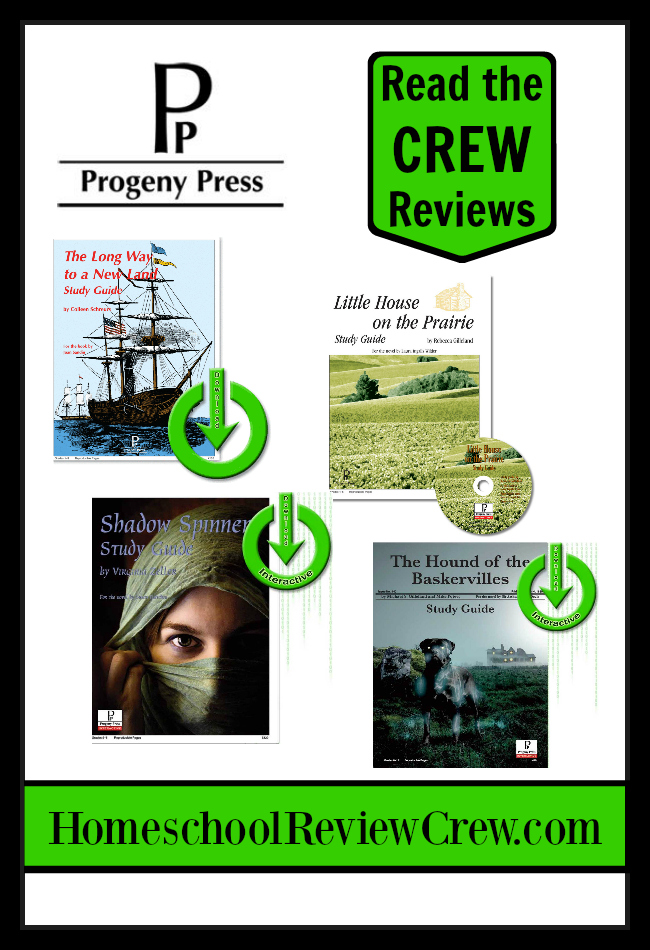
Members of the Review Crew were given their choices of four study guides, one for each level of schooling (Early Elementary, Late Elementary, Middle School and High School).  Be sure to click on the banner below for the opportunity to read their reviews today.

Study Guides for Literature {Progeny Press Reviews}


Thursday, May 9, 2019

Pattern Explorer Beginning (A Homeschool Crew Review)


The Critical Thinking Co. understands that students need to develop their critical thinking skills in addition to just memorizing information.  Members of the crew have been reviewing their choice of 8 different workbooks from The Critical Thinking Co.™ with their students to work on these valuable skills.  Our family chose to review Pattern Explorer Beginning to use in our homeschool.

About The Critical Thinking Co.

Established in 1958, The Critical Thinking Co. has set a goal of producing award-winning products that help students to achieve better academic results as they sharpen their reading, writing, math, science and history skills while improving their critical thinking abilities.  By creating lessons that require the student to analyze what they are reading and learning, their hopes is that students improve both their grades as well as test scores as they learn to analyze information and use higher critical thinking skills to apply that information to their classwork and lives.  The Critical Thinking Co. does not believe in drill and memorization but instead believe that the development of these critical thinking skills produces better results.

About Pattern Explorer Beginning


For this review, we were given the Digital download version of this workbook.  Upon downloading the file and installing it onto the computer, the software must be registered using the license given to the user upon purchase.  Once registered, the user has complete access to the full workbook which can be printed out easily for one or more students.  The digital workbook is the same as the physical workbook of the same title. 


This workbook is targeted for students Grades 3-4th and use various math skills to solve: addition, subtraction, multiplication, division, and more. 

There are 5 different types of pattern problems that students will be asked to solve in this book:

  • Pattern Predictor  
  • Equality Explorer
  • Sequence Sleuth
  • Number Ninja
  • Function Finder
Through the course of the book, the students will be asked to solves these five type of problems, with each type being rotated throughout the book.  Each type of pattern problem will be repeated 8 times over the course of the 40 activities found in the book. 


The workbook itself is 88 pages in length. The first 4 pages of the workbook consist of the title page, table of contents, author information and introduction.  Following that are 48 page that cover the 40 different exercises for the student to work.  The remaining pages contain the key for the solutions for the exercises as well as hints for each activity to help encourage and guide the student to figuring out the solution when they hit a dead end.


How We Used This

We have been using Pattern Explorer Beginning as strictly a supplement to our math assignments and the kids love it.  After installing the EXE file onto my computer, I simply opened the program and then printed two copies of the first 20 pages.  These I keep in a folder and a few times each week, I give a page to the kids work on.   The kids routinely asked if we could work on "Pattern Math" and would celebrate when I grabbed that folder.  I didn't pick any particular day to use them - just scattered their usage throughout the week when I thought the kids needed a fun activity, such as after a long reading assignment or when they were having a bad morning.


And to be perfectly honest, some of our silliest moments in our school lately have revolved around working out one of the activities together..   Here's the kids telling me how much my drawing skills suck - just as an example of the silliness we've had together using these worksheets.


 Each activity uses and builds upon the skills they already know but don't like to practice, in a fun way in which they seem to forget that they don't like doing it.  I guess algebraic expressions seem much more fun when you're figuring for half moons and stars rather than X and Y.


Each sheet would take us roughly 10-15 minutes to complete and typically, we would work it out together with me writing the problems on our dry eraser board and having the kids walking me step by step through solving the various problems.

While we have gotten through a good percentage of the book, I have no doubt that we will easily be able to reprint pages and repeat the exercised without the kids objecting (or even realizing they are repeating them). Once I feel comfortable with their skills, I'll most likely purchase the next book of this series from The Critical Thinking Co.

#hsreviews #TheCriticalThinkingCo #EmpowerTheMind


For more information about The Critical Thinking Co. and the vast library of resources available for purchase, including Pattern Explorer Beginning, be sure to visit their website .  You can also find them on the following social media sites:


Between now and the end of the year, Get Free Shipping + 15% Off Any Size Order!

Coupon: TOSCREW19

Expires: 12/31/2019


Members of the Homeschool Review Crew were given their choice of 8 different products from The Critical Thinking Co. that covered language and math skills for different grades.  Be sure to click the banner below to read their reviews and see if any of them might be a good fit for your particular student.


Critical Thinking, Math, Vocabulary & Writing Skills {The Critical Thinking Co. Reviews}

Wednesday, July 18, 2018

Progeny Press (A Homeschool Crew Review)


When I was in school, one of my favorite courses was my English classes. Even in college, I enjoyed my college literature classes because it was in those classes that I was given the opportunity to read and enjoy classic literature.  However, last year, my oldest daughter graduated from high school.  In the course of her schooling, I was very disappointed to find that she didn't really read much as far as classic literature.  No Victor Hugo, Leo Tolstoy, Jack London, Ernest Hemingway, Nathaniel Hawthorne, Bronte sisters, Mark Twain, or even William Shakespeare, which were required reading when I was in school.

One of the things I enjoy most with homeschooling is that I can have control over what books my younger kids have to read through their school years.  I want them to learn to read, appreciate and even love classical literature.  Progeny Press allow me as a parent to go well beyond just reading the story with them. Using their study guides to dive deeper into the story using questions and activities, students are able to develop critical thinking skills, interpretation skills and go beyond just the surface of the story.  For the last few weeks, the kids have been using The Green Book - eGuide from Progeny Press to better understand The Green Book by Jill Patton Walsh.

About Progeny Press

Progeny Press is a publishing company who offers E-guides for literature with a Christian perspective. Offering guides for reading levels from early elementary through high school, each of the Progeny Press guides are designed to help students to better understand the story they are reading as well as to recognize the themes presented by the author. The units contain study questions as well as recommended map work, research ideas, vocabulary lessons, and even Biblical verses that tie into the story.

However, what makes Progeny Press different from other literature study guides is that Progeny Press uses Biblical teachings, backed with scripture, to tie the story into practical lessons. While many books contain content or beliefs that do not align with Christian beliefs, Progeny Press guides direct students to instead study what God says about such things so they will be better prepared and strong in their faith when they face such behavior, language, and philosophy in life. 


How We Used It


We reviewed the 57 page  downloadable E-guide version of The Green Book study guide by Rebecca Gilleland as well as a 6 page Answer Key that accompanies the study guide. The chapter book must be purchased separately from the study unit but it is offered for sale on the Progeny Press website. This particular study unit is recommended for Upper Elementary and is recommended to be used for grades 3rd-5th.  I used it with Ash and Garrett as we read through the book together.

The E-Guide is broken down with questions and activities to use with each chapter of the book.  The activities include vocabulary exercises, word searches, crossword puzzles, venn diagrams, and even a mystery message activities that the kids really liked. At the end of each chapter of the E-Guide is various suggestions on projects and activities to do after completion of the book that tie in arts and crafts, cooking and oral reports.  Utilizing these activities helps to tie other subjects such as Science and physical activities into the study.  (The kids especially enjoyed learning about Fire Opals).


I hate saying it, but the kids and I didn't care for the book itself.  Luckily, I'm not reviewing the book.  The study guide, on the other hand, is very nice and we enjoyed all the various activities.  I especially liked the vocabulary activities where the kids had to take a guess at a words meaning based on the context it was used in the story.  I enjoyed listening to the guesses that the kids made and seeing how correct they were.  For example:  the kids were introduced to the word "treacle" from the text "But what he showed us[...]looked a funny hue, as though someone had brushed it over with a layer of treacle."  This was a word the kids had never heard before.   Ashleigh guessed it meant a blanket  while Garrett thought it had something to do with a tree.  Now, they both know that treacle is the British term for molasses.  The study guide has plenty of vocabulary building exercises like that. 


I've used other Progeny Press Study Guides in the past and I have always found them to be well written and thoroughly cover the books main topics.  Each guide really does well to expand beyond just reading the book but also understanding the underlying elements.  But mostly, I am glad that when it comes time for my kids to read Huckleberry Finn, Beowulf, Julius Caesar or Jane Eyre, these guides will be waiting to help them develop a true understanding of Classic Literature.


For more information about Progeny Press and their large selection of literature study guides, visit their website. You can also find them on the following social media platforms:


New Study Guides for Literature From a Christian Perspective {Progeny Press Reviews}


Disclosure

Disclosure
Related Posts Plugin for WordPress, Blogger...